
Long before man began clumsily shoving tones together to create his chords and scales, and artificial harmonic systems, there was the Harmonic Series, an entire architecture of frequencies hidden within his own voice. Every tone - every bird song, animal call, and flute-whistle - was and is built upon the same naturally-occuring acoustical structure. It should be no surprise, then, that after millions of years of hearing and speaking these tones, we have attained a deep familiarity with this structure, such that it occupies a central place in our perception of sound. The Harmonic Series not only a harmony; it is man's first and most fundamental Harmony, the sole acoustical form by which he envisions something akin to order within the acoustical world.
The field of music theory suffers, in part, because it has failed to investigate the deeper structural component of the Harmonic Series. Western music theory has not grown out of its pitiful reliance on Pythagoras' ideas. Pitch-classes, intervals, ratios: even now, these terms dominate our theoretical language; meanwhile, the Harmonic Series is either downplayed or outright ignored. Neo-Reimannians have completely discarded the Series from their systems. Harry Partch states early on in "A Genesis of Music" that harmonics "have no bearing on Consonance." But even on the rare occasion when a theorist attempts to relate music to the Harmonic Series, he does so callously. The traditional theorists - Rameau, Riemann, Schenker, etc. - viewed the 7th harmonic as contradictory to Western systems of Harmony and so, in cowardly deference to their own culture, discarded every harmonic higher than the 6th. Modern psychoacoustics, in an attempt to be "empirical," outsources all of its questions to study-groups, as if the hard problems of music theory can be solved by asking for a show-of-hands. We have this naturally-created acoustical structure which seems to be the Platonic form underlying all of our artificially produced Harmonies, and we actually refuse to touch it!
What is meant when we say "acoustical structure?" At a superficial glance, the Series is just a spectrum of frequencies stretching from low to high. But a keen ear detects its underlying structural aspects. Certain harmonics are more important in fleshing out the overall sound of the Tone than others. The tonic is clearly most important; harmonics 2, 3, 4, 6, and 8 are pretty important too; harmonics like 7, 13, and 19 can be done away with without impacting the sound at all. Harmonic multiples bare phenomenological resemblance to each other in much the same way as two shades of the same color-group. For instance, harmonics 2, 4, and 8 are very alike. 3, 6, and 9 are alike. 5, 10, and 15 are alike. In short, the Harmonic Series is brimming with special harmonic relationships which run deeper than its mere ordinal component. The series is not a straight line, but a vast and intricate network of harmonic identities.
Our goal for this blogpost will be to roughly model this network. By doing so, will make apparent the inner-logic, not just of the Harmonic Series, but of the infinite array of harmonies derived from it.
Our acoustical hierarchy begins with the most fundamental of all the harmonics, the tonic. The upper-harmonics assimilate into the tonic's pitch; NOT the other way around.
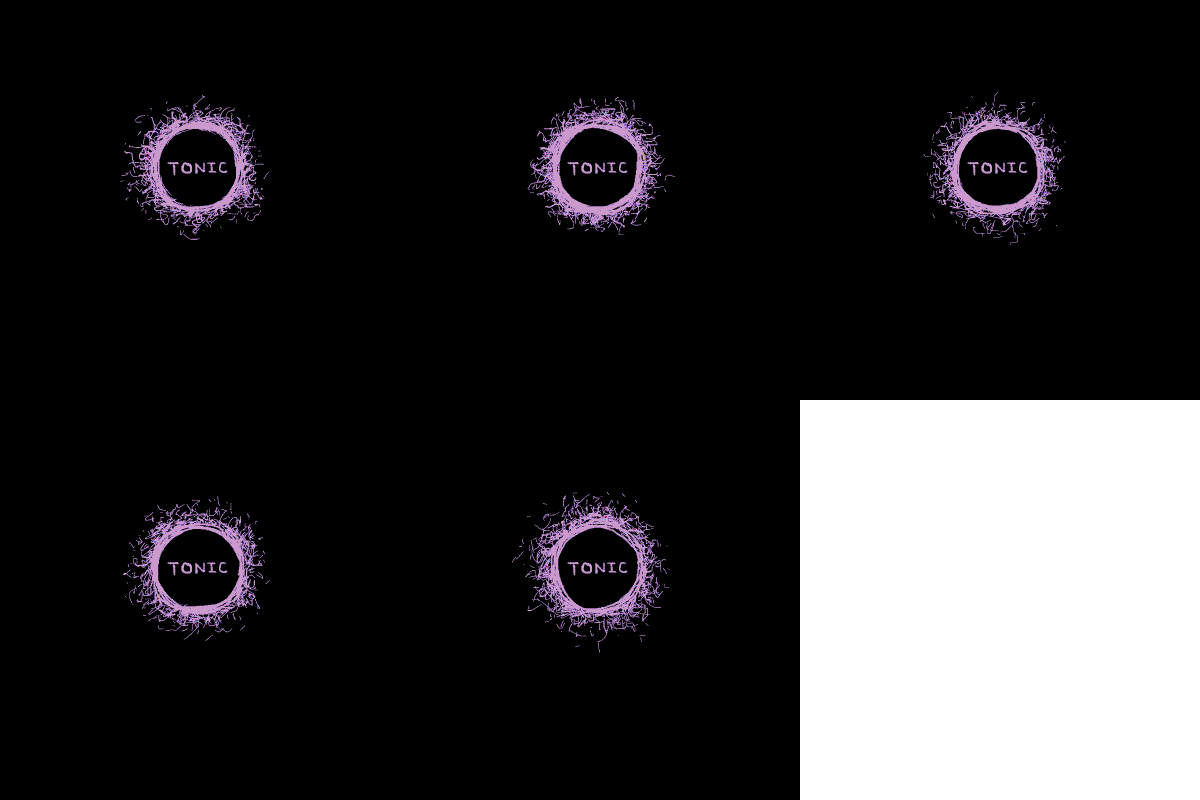
Out from the seed of the tonic springs the entire branching network of harmonic identities. First comes the 2nd harmonic, the tonic’s double, the first and most rudimentary extension of its pitch-feeling into harmonic space. From this twin-like relationship between 1st and 2nd harmonic, we get the so-called "octave."
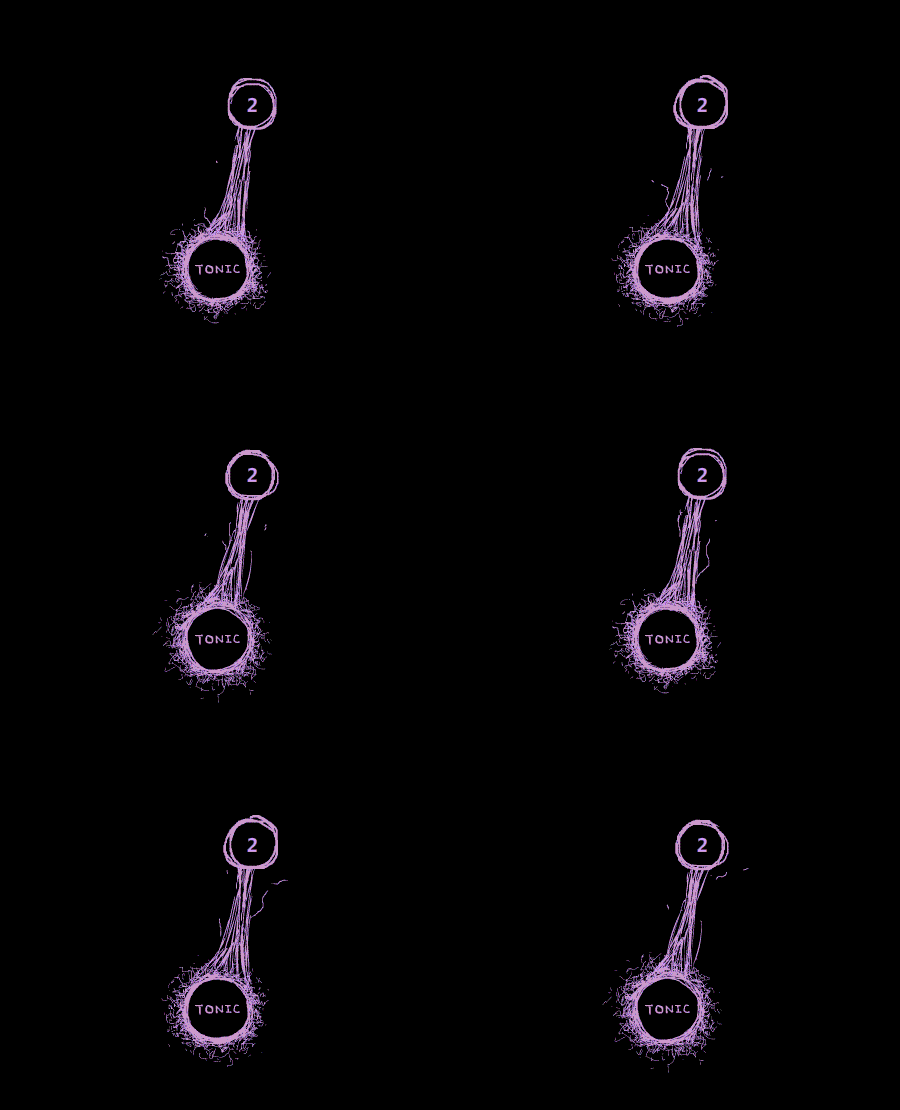
Then, out from the 2nd springs the 3rd, which creates our “perfect 12th” interval.
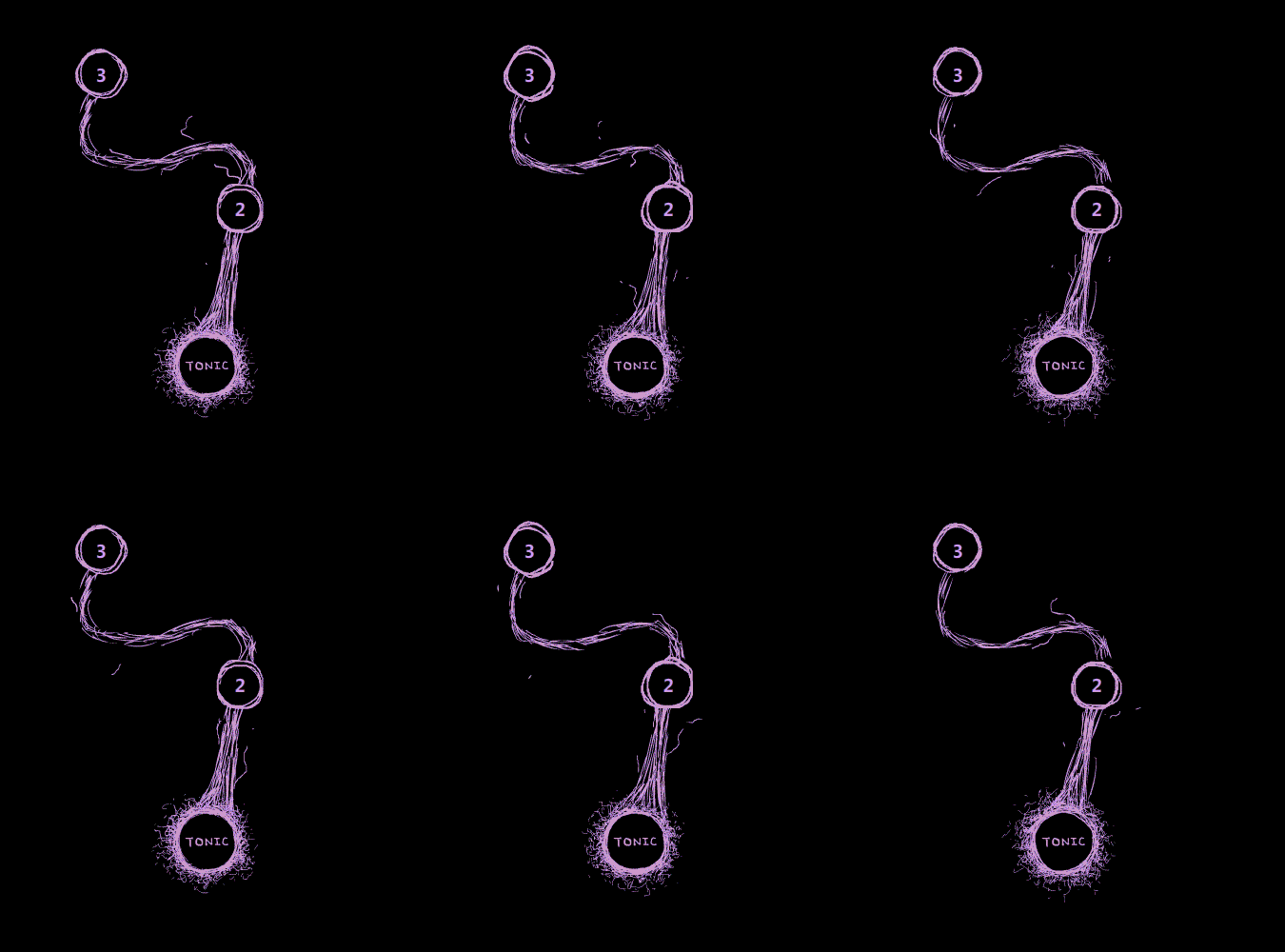
The 2nd and 3rd harmonics are entirely separate acoustical identities; each one deviates from the tonic in its own phenomenologically distinct way. If the Series continued along in this way, with each successive harmonic baring no resemblance to any previous one, we would not be very justified in calling the Series a structure. But, in the 4th harmonic, we get, for the very first time, an acoustical identity which is not something new. The 4th harmonic evokes an acoustical feeling almost identical to that of the 2.
Basically, the 4 is "2-like" because it is the 2 of the 2. Get it? The 4th harmonic relates to the 2nd harmonic in the same way that the 2nd harmonic relates to the 1st. And this is, in fact, the very same way in which the 8th relates to the 4th, and 16th to the 8th, and so on. All of these harmonics - 2, 4, 8, 16, etc. - are powers of 2 and, as a consequence, are gradually weakening reflections of the 2nd harmonic.
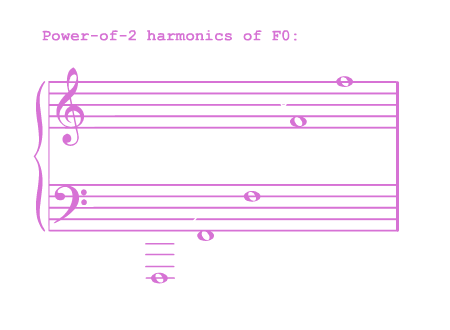
One great collective oversight of music theorists is that they acknowledge this recursive feeling in the powers of 2 - they call it “octave equivalence” - but they fail to recognize that this exact same phenomenon of “equivalence” is shared by other harmonics.
The 9th harmonic, for instance. Anyone who is listening to the 9 clearly can sense that it has the flavor of 3 in it, that it is not a phenomenologically unique identity, but one which is derived from the 3 in exactly the same way that the 4-identity is derived from 2.
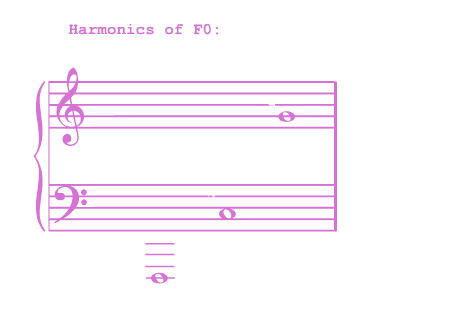
The powers of 3 evoke a gradually diminishing “3-feeling” in exactly the same way as the powers of 2.
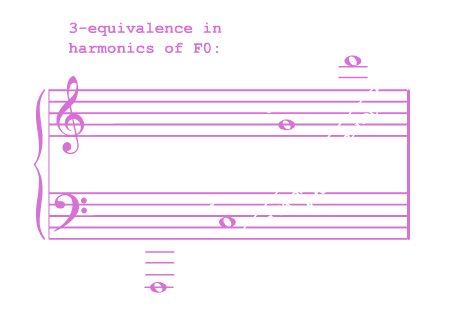
So yes. There is such a thing as “octave equivalence,” but there is also a 3-equivalence and a 5-equivalence and a 7-equivalence. And once this is realized, we can begin to envision the broader arithmetical logic which commands the Harmonic Series.
Prime-numbered harmonics such as 2, 3, 5, and 7 are all phenomenologically distinct from each other; each one evokes an entirely unique acoustical feeling. On the other hand, compound-numbered harmonics such as 4, 8, 9, 10, and 12 derive their respective acoustical feelings from the prime identities of which they are multiples. When we hear the 4th harmonic, we are hearing the 2nd harmonic’s 2nd harmonic. When we hear the 6th harmonic, we are hearing the 2nd harmonic’s 3rd harmonic. When we hear the 15th harmonic, we are hearing the 3rd harmonic’s 5th harmonic. Compound-numbered harmonics are downstream from their parent-primes.
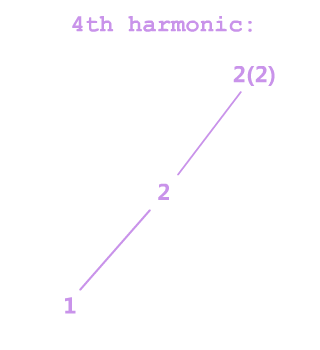
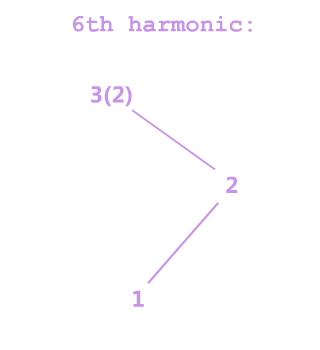
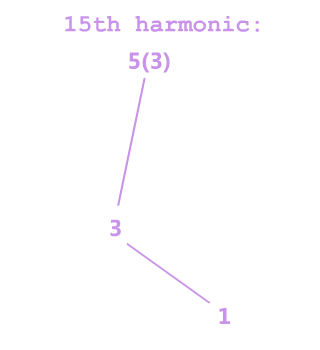
By charting these harmonic relationships, we can map out the broader shape of our network. The prime identities are the tonic's direct offshoots; they form the main "trunk" of the Harmonic Series. From each of these prime identities, we can imagine a "branch" of specialized identities sprouting. These specialized identities bare the residual feeling of whichever prime they extend from. The 2nd harmonic, for instance, generates a branch consisting of 4, 6, 10, 14, etc. throughout which one hears a generally diminishing 2-feeling. The 3rd harmonic, likewise, generates the branch 6, 9, 15, 21, etc. It is as if each harmonic is, itself, the tonic of its own sub-series.




The Harmonic Series, therefore, is best imagined as a kind of acoustical fractal, generated by the recursion of a single series of primes.

By this recursive process, we generate The Harmonic Tree: a sprawling network of Harmonic identities branching outwards infinitely from the initial tonic-seed.
The Harmonic Tree we have proposed is more than just a metaphor for describing the relationships between harmonics; it is also a map indicating the variance in structural importance throughout the series.
As I touched upon in my last article, certain harmonics are more structurally important than others. Like the blocks which make up a building, certain harmonics act as foundation whereas others are merely decorative. That is to say, the Harmonic Series consists of a combination of strong harmonics and weak harmonics.
For example, a tone consisting only of harmonics 3-8 sounds pretty normal:
While a tone at the same pitch consisting only of harmonics 13-18 doesn't actually sound like a tone at all:
From this experiment, we can see that harmonics 3-8 are more integral to the structure of the Tone than harmonics 13-18, becuase latter group can be sacrificed whereas the former cannot. In other words, harmonics 3-8 are inherently stronger than harmonics 13-18.
Every harmonic within the Series has an inherent degree of harmonic strength. This degree of strength determines its importance within the overarching tonal structure.
Naturally, the tonic is the strongest harmonic in the series. From there, the harmonics generally weaken in strength as their number approaches infinity. “Generally" is the operative word here. By no means does harmonic strength decrease in a strictly ordinal fashion. The 4th harmonic is stronger than the 3rd harmonic. The 9th is stronger than the 5th. The 12th is stronger than the 7th. Harmonic strength seems, at first glance, to vary quite irregularly from harmonic to harmonic.
In actuality, harmonic strength correlates exactly with the acoustical hierarchy which we have mapped out in our harmonic tree. The 4th harmonic is stronger than the 3rd, because it is structurally closer to the tonic. The 4 does not introduce a new prime-identity; rather, it is a deepening of the strong 2-identity. By contrast, the 3 introduces an entirely new structural domain. So although 3 is lower in number than the 4, it still represents a greater structural departure.
If we isolate the prime-numbered harmonics, regarding them as their own prime-series, we not only notice that they weaken strictly from harmonic to harmonic, but that they seem to do so at a logarithmic rate. 1 is the strongest harmonic. 2 is only slightly weaker. 3 is still quite strong. 5 is where harmonic strength starts to noticeably diminish. 7 is much weaker. 11 is extremely weak. By the time we get to 11 and 13, we are at an extremely negligible degree of structural relevance. If we were to draw a graph mapping harmonic strength onto the primes, it would look like this:
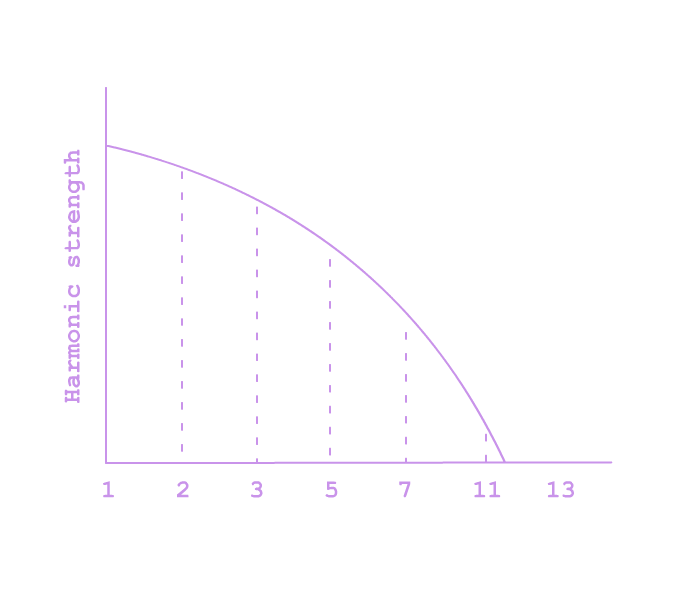
And because the entire Harmonic Series is generated by the recursion of this initial series of Primes, each recursion weakens at an identical rate to main series. In order words, the decay of each harmonic "branch" mirrors the decay of the prime "trunk," scaled by the strength of its original harmonic.
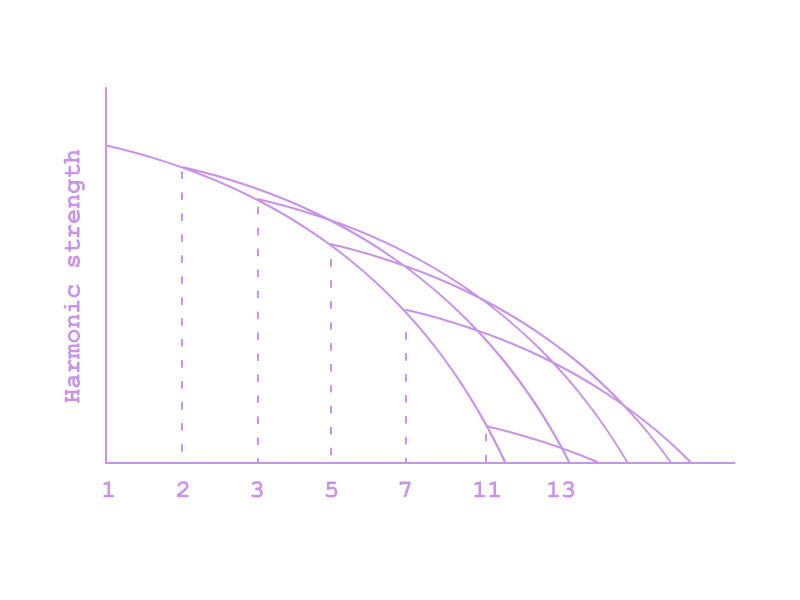
Therefore, harmonic strength does not depend on a harmonic’s number but on its prime-complexity. Harmonics made up of small primes - especially 2 or 3 - retain structural strength, while harmonics introducing large primes - such as 7 or 11 - represent structurally weaker harmonic departures.
To formalize it into a law: harmonics weaken as prime factorization complexity increases.
This law explains every variance in harmonic strength throughout the series! It explains why 4 (2x2) is stronger than 3, why 9 (3x3) is stronger than 5, why 12 (3x4) is stronger than 7.
When a tone’s timbre reflects its harmonic structure - that is, when the amplitude of each harmonic is proportional to its own inherent strength - the tone will sound purely consonant. This falls in line with what I proposed in my last article: that there is a “normative timbre” which a tone must roughly conform to in order to be heard as purely consonant. Pure timbre can now be more adequately defined as when the distribution of amplitude throughout a tone’s harmonic series reflects the natural distribution of harmonic strength.
If all that I've said is correct, timbres which conform to natural harmonic strength (NHS) should always sound more pure/consonant than tones which do not.
To test the validity of my theory, here is first a tone which conforms highly to NHS:
And here is a tone in which the amplitudes of harmonics decrease in a strictly linear fashion:
And, at last, a timbre which deviates entirely from NHS:
I don't know about you, but, to me, the first tone sounds very pure, whereas the second tone sounds a little nasally/dissonant, and the final tone sounds clangy and metallic. Clearly, as timbres deviate more and more from NHS, they become less and less pure, gradually distorting into dissonance.
Let’s tweak our Harmonic Tree diagram to reflect the variance in Harmonic Strength throughout the Series. We’ll adjust the length of the lines between harmonics so that each line-length corresponds directly to the lessening of harmonic strength between two harmonics. Because 2 is barely weaker than 1, the line between them is short. Because 11 is far weaker than 7, the line between them is long. Following these adjustments, we get the following map:

Here, we have created a rough map of harmonic strength throughout the series, where any given harmonic’s strength is directly proportional to its proximity to the tonic.
Everything that I'm doing here is very approximate. I haven't made concise measurements, nor even attempted to reduce all of this to a clear, concise formula. I'm more interested in the general pattern of these harmonic structures than finding ways to quantify them.
The pattern is Tree-like hierarchy. The prime-base is strongest, while, as the tree extends outwards, it splits and branches out into many weaker sub-series. As it continues to divide into thinner and thinner harmonic branches, it grows increasingly complex until, eventually, we reach a chaotic field of overlapping harmonics which is indistinguishable from Noise. The harmonic tree is rooted in a strong tonic and gradually fractalizes into Noise at its farthest edges.
